Tuesday, February 4, 2020

Time's up on our Two weeks of Travel

5 Jan 2020

Today I was feeling my best yet (thank goodness) so getting up and out to the train with my pack wasn't a problem. What was a problem, however, was that we had booked our flight with a nonexistent airline. Adria had gone bankrupt and was not flying our routes any longer which meant we had no way to get home. UUGGGHHH. We had two options- one was a direct flight that left around 11am, the other had a 5.5 hour layover in Turkey and didn't get us back to Tirana until 11 at night. We used all of our miles and then some to rebook flights 😣 It was definitely a sad, sad moment. Adria got us once, shame on them. Adria got us twice, shame on us. To lessen the blow we ate pastries the size of our faces and hunkered down for the four hour wait in the airport.


Sick Sick Sick

4 Jan 2020
Mark smuggled me up a piece of toast and a banana from breakfast (no eating in rooms!) that I was able to keep down. Although I was feeling a bit better, I was still very weak and incredibly nauseous, so it was a day spent in the hostel. By mid afternoon I made it downstairs to the common area so that Mark and I could play some games and have a late lunch.


I went to bed early in anticipation of my 6am alarm for the next morning.

Goodbye Kenya, Hello Frankfurt

2 & 3 Jan 2020

Up for breakfast and then time for showers and packing. After checkout we decided to walk the inland beach road to explore the local shops and stands. It was HOT. We kept getting propositioned by tuk tuks and motorcycles but we wanted to walk and stop, walk and stop, which wasn't really conducive to transport so we refused. After shopping we tried walking toward the water and stopping at a beach bar for a quick bite, but there weren't any small options, only large fish platters accompanied by sides, so we continued on and made it back to Bahari Dhow where we split a sandwich as we watched the waves. By mid afternoon it was time to bid farewell to Diani.


Our trip to the airport was a bit bumpy (our driver backed into a stone wall and knocked the bumper loose, in addition to running a tuk tuk off the road and getting stopped twice by the police for jumping the ferry line). Oh yeah. About the ferry... We had to drive our car onto a ferry to cross from Diani to Mombasa. WHAT?! I was definitely not expecting that, at all. I also wasn't expecting to see a mini bus with a casket strapped to the top. Our driver casually explained that's how families transported their loved ones and that this particular bus would be driving 56 hours to get to its final destination. WHAT?! We were glad once we finally made it to the airport and crossed our fingers that our drive there was going to be the craziest part of our next 13 hours of travel...


This just in: MONKEYS in the airport. Things just got a whole lot crazier folks. 


Our flight left WAY late so the passengers boarding our plane were the only humans in the airport. I left our "checked in area" to go to the toilet and there wasn't a soul, much less a sound. We made it to Adis Ababa and through security and in contrast, it was packed. However, in comparison, our flight here also left WAY late so by the time we were boarding it was the middle of the night. Miraculously though we only landed slightly after the time scheduled, due to fast flight time apparently. Before I transition to the final leg of our adventure, I want to share a compilation video that Mark made of our time spent in Kenya. It makes me smile from ear to ear and I hope watching it does the same for you 😁

We were through customs and to our hostel before 630 and the guy behind the desk was bamboozled. Maybe still a bit drunk from the night before? The place was a mess and we were told no way no how we'd be able to check in until 4pm. FOUR?! WOOF. We grabbed a quick nap on the cubes next to the pool table before heading out for a 10am walking tour. Our guide was a local Frankfurtean and started off by telling us we were in the red light district (obviously) and that this area had gone through a gentrification so there was a mixed population of aristocrats alongside drunkards and druggies (obviously). We had encountered both of these during the hop, skip and the jump it took us to get from our hostel to the tour spot. Anyway, we learned that Frankfurt is the main hub for banking in Germany and the EU. It's also home to the 10 tallest buildings in all of Germany. Frankfurt is currently undergoing heaps of construction as they are trying to appeal to the bankers living in London who will surely relocate if Brexit occurs. Frankfurt is also building working/living communities that include teachers, doctors, grocers and the like living and working under the same roofs so they rarely have to access the outside world. Uummm... not sure how well that one's gonna catch on, but you do you, Frankfurt. This skyscraper part of town is in stark contrast with the "old town" that was rebuilt to reflect the historical Frankfurt from years ago. After the war, most of the architecture was either destroyed, or occupied by the American forces which caused Germans to tear it down and rebuild it once it was their own again. On the sidewalks are small gold plaques, or stumbling stones, meant to make you misstep, look down and then remember the Jewish people who lived in the neighborhoods and then were taken from their homes and forced into concentration camps. Eerily enough, there's a large circular plaque located in the old town square memorializing the site of the banned and burnt books. Heinrich Heine, one of the renowned poets at the time said, "Where they burn books, they will too, in the end, burn people." A hundred years later, the Nazis were doing just that in concentration camps throughout the country. 


After our tour of Frankfurt Mark and I went to Kleinmarkthalle, a huge indoor warehouse of vendors selling everything from meats and cheeses, to spices, to fruits and veggies to wines to flowers. It's really large, and after exploring, we created a hand picked plate at one of the deli counters. We were a bit overzealous with our cheese portions, and ended up with a ton left. 


We decided to walk back to the hostel with the hope that we'd be able to get in by 330. Sure enough we could and thank goodness, because almost as soon as we got into our room I got sick and spent the rest of the night in bed.

Happy New Year

1 Jan 2020

Happy New Year! We had a most wonderful beach day filled with dominoes, reading, walking and relaxing. I couldn't have asked for more fun in the sun. 


In the evening, we walked down the beach to another resort that we had passed during the day. It was obnoxiously high end and we couldn't eat in their restaurant without putting down a cash deposit that needed to go through the currency exchange counter. It was quite an ordeal. The resort was massive and had three huge dining halls with tables and tables of food. I mostly enjoyed eating the fresh fruits and veggies, but indulged in some naan and chapati on the side. After dinner we went to the sprawling lawns for the entertainment. It was a pair of brothers from Mombasa who were doing all things entertaining-- juggling, gymnastics, magic, dancing, comedy and more. It was a fun change for our evening. After going back to the resort's currency exchange to get our deposit we grabbed a motor taxi back to Bahari Dhow. (We heard conflicting things about whether it was safe to walk along the beach or in the road after dark so we negotiated one for 50 shilling (about 50 cents) to take us a hop, skip and a jump away.) We headed to the beach bar for one last round of drinks to be enjoyed while watching the waves crash against the sand and the stars shine their brightest. It was a wonderful last night in Diani Beach, Kenya.

you say kwaheri, i say karibu

31 Dec 2019

It's New Year's Eve. Mark and I woke leisurely at 730 and lounged in bed until 815 or so. We were both really excited at the prospect of moving to a hotel along the beach today. Unfortunately, the email says we can't check in 'til noon, but Mark called and they said 11. We're going to try to get there around 10 and take advantage of their breakfast and then hit the beach early. Wish us luck!


We couldn't check in until 2, but they held our bags and sent us to their restaurant on the beach. The breeze was beautiful and the beach was buzzing with activity. Unfortunately we arrived between the breakfast and lunch hours, so it took an hour and a half for our food to arrive- yikes. In the meantime we were able to check into our room and reserve a table for the NYE party happening in the evening. We spent the day on the beach, walking, lounging and soaking up the sun. Dinner was a buffet affair with many added tables and chairs. We enjoyed a variety of foods and after eating, moved to the bar area where we heard live remixing from DJ Never in between performances from local singers. The entertainment was great, the drinks were good and the beach was the place to be at midnight, because some of the other hotels were shooting off fireworks over the water. Mark and I met some new people, danced to some new music and rang in the new year with some new kisses. As they say in Kenya, kwaheri 2019, karibu 2020. (Goodbye 2019, Welcome 2020).

beach life minus the actual beach

30 Dec 2019

We were up early in order to say our goodbyes to Lavender (my hospitality friend with big dreams!) and Jakub (our favorite server), before hitting the road. We drove the four hours to the airport where David was more than happy to get rid of us.


He dropped us three hours early in an airport that's the size of a shoebox. We've been hunkered down in the food court ever since and CANNOT WAIT TO GET TO THE BEACH 😎🌞🙌


After quite a bit of thumping and skidding we landed safely in Ukunda. It's aptly named "Ukunda airstrip" as it's no more than a runway and a parking lot. Our accommodation was nowhere to be found on maps, so I called and asked them to give our taxi directions. Our taxi driver took us to the wrong spot, incredibly close to the airport, so we tried to show him that he needed to keep going. He then told us that he had a pickup scheduled and needed to bring us back to the airport with him and drop us after. No thanks. We ended up getting out on the side of the road and hailing a tuk tuk.


Those are way more fun and way cheaper. We arrived at Masai Paradise Cottages and were a bit underwhelmed. We were used to everyone at the tented camps being so friendly and welcoming. Here we had to search for someone to check us in. A simple head nod let us know to follow this woman to our room. She unlocked the door without a word, plugged in the refrigerator and walked out. Surely she'd be back. And she was. She returned with two bottles of water and then turned to leave. "Umm.. excuse me," I said. She just looked at me. Ok, this was going to be like pulling teeth. I asked about coming and going--- there will always be someone at the gate so come and go whenever you want. I asked about wifi-- she showed me a picture of the password. I asked about food and drink-- there's none; we have to provide our own. I asked about animals--- no animals to worry about here. She then told me she was supposed to go home and walked out. Hhhmmm... As I turned a monkey was staring me in the face. No animals to worry about here my ass. I quickly closed our door and we contemplated our situation. It wasn't bad. We've definitely stayed in more rustic accommodations, however, after camping, we were both really excited for beach life. Mark had some work to do so we took advantage of the wifi and then decided to walk to the beach and find somewhere to eat dinner. Unfortunately the main road isn't lit. We walked to a resort with hugely ominous doors staring down at us and asked how to get to the beach . It was about a 15 minute walk to the first access road. Since it was pitch black we hailed a tuk tuk and paid less than two dollars to go the distance. The tuk tuk driver asked where to drop us and we told him we were just going to wander up and down the beach to find a restaurant. He explained that it wasn't safe for tourists to walk the beach at night because of pickpockets so told us he would drop us at a seafood spot at the top of the access road. He told us to call him when we were finished and he'd come get us. Hhhmmm... The outdoor seafood spot looked very inviting-- candles on each table nestled cozily between the trees and the sand. Upon arrival we learned that the power had gone out for the whole block and that the Kenyan Electrical Authority was out in their trucks trying to fix it. We ordered but had no idea how long it would be until we could eat. While waiting we decided that we needed to make a change. If we couldn't walk the beach in the evenings then we were very limited in what we could do. If we couldn't eat, drink or meet other travelers at our accommodation then again, we were very limited in what we could do. We looked on booking and found a hotel on the beach with availability for the next two nights. A pool, free breakfast, bar and restaurant, in addition to NYE activities. We decided to book and almost instantly after, the power came back on-- we thought it was a sign 😉 Mark enjoyed a rich vegetable curry while I worked hard to rid the crab shells of their deliciously tender meat. It was a filling meal, with rice, potatoes and drinks, right near the water, for barely fifteen dollars.


We decided to head back to our cottage and play cards on the porch because the cool breeze was so inviting. We celebrated the fact that we could stay up as late as we wanted (no alarms for 6am safaris) but by 1130 could barely keep our eyes open (oh how old we've become!) It was an unexpected first night at the beach. 

Sunday, January 26, 2020

Making Friends with the Masai

29 Dec 2019

Up and at 'em for our 630 game drive. David found out that the road we had taken yesterday was closed because of flooding (shocker!!) so we had to use an alternate road. In the light of the morning we enjoyed the elephant herds roaming and feeding, the zebras grazing and the topis twirling their tails about. We saw many different types of birds, but no lions.

On our way back to the camp we witnessed an elephant standoff. David explained that the two animals facing one another across the road were fighting for dominance within the herd. The larger elephant, with the bigger tusks, was the older one, and he was being challenged by the younger male with smaller tusks. The younger male kept using his trunk to throw dirt over his body and pull his foot back and forth in the dirt while waving his ears. The older elephant just stared, occasionally moving his ears. David explained that it could take hours, days or weeks for the final showdown. The females in the herd would accept whichever male was dominant and banish the other.

We returned to camp around 930, just in time for breakfast. Mark hit the showers once he finished eating, but I stayed for a hot tea and a chat with one of the chow tent workers, Lavender. Her hair was braided in an absolutely beautiful way culminating in a crown around the top of her head. She explained that it wasn't her real hair and that when she got this style done it took about two and a half hours and could be left in for three to four weeks. She marveled over my hair, exclaiming how beautiful it was when styled naturally. We laughed at the age old saying, "you always want what you can't have." Lavender is originally from Nairobi but was attending school for hotel management. She finished school and was called to work at Kibo Safari Camp shortly after graduating. She's been here almost a year and hopes to gain enough experience to open her own hotel one day. She prays that if she works hard and has faith in god she will succeed. Talking with her was lovely and I wish her all the best. 

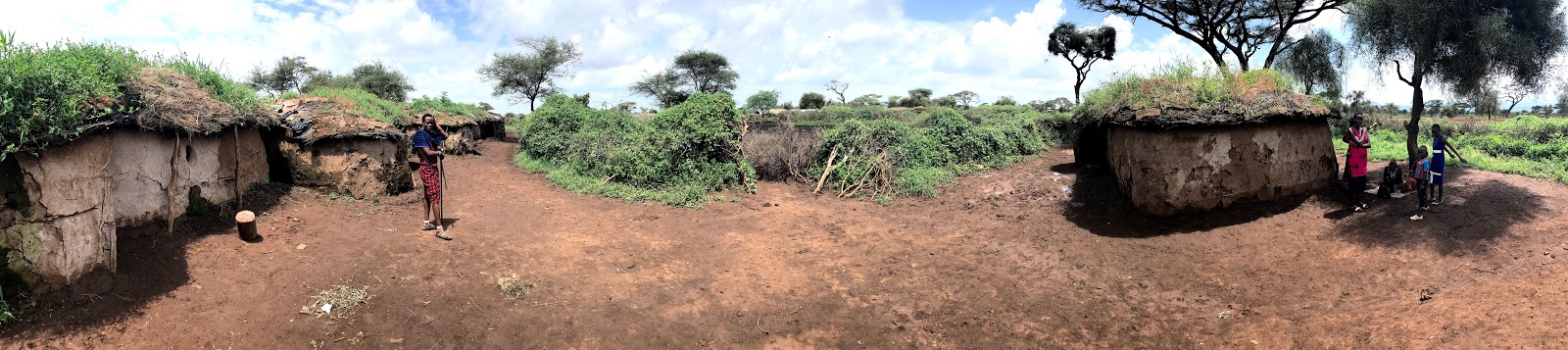
Mark and I then met a local Masai, Ramone, who took us to his village. It was a thirty minute walk from Kibo and it was in and out of swamp, thick mud and tall grasses with one constant: heat. We walked by a permanent school, and hospital, both built by volunteers from the US. These are the only two buildings in the village with power and running water. As we continued we finally came to the Masai camp, which included an outer fence made of bushes and trees, to protect from wild animals, followed by a circle of eight huts followed by an inner circle where livestock were kept.


The Masai first showed us how to make fire using a combination of zebra and elephant dung powder, wood and sticks. The process was really slow and caused the men to inhale tons of smoke but eventually the fire started. I couldn't imagine doing this each time I wanted to cook, drink water, or keep warm.


We then went inside a Masai hut. The huts are built first with strong special sticks from Mt. Kilimanjaro. These are gathered once per year. 10 men and 10 donkeys from the village make the two week trip. During the rainy season this wood is stored in the huts to ensure it stays dry. Once the women are ready to build a new hut (all Masai homes are built by women) they combine the wood from Mt. Kilimanjaro with wood from the acacia trees to make the base. They then cover the base in cow dung which acts like a cement and an insulator. The roof is made from nylon paper and sticks. The houses are subject to flooding and termite damage but the combination of wood keeps them strong and durable for up to twenty years. The homes are incredibly small. The one Mark and I entered had two rooms, one for the women and children and one for the men. A small bed is raised off of the floor using wooden beams and is covered with cow hide. In the center of the hut is a small fire that continuously smokes (this keeps the mosquitoes away) and also serves as a place to boil water and cook food. There are no toilets or showers. Because the homes are made of dung the amount of flies is unreal. You can tell that Mark and I are tourists (for many reasons!) specifically because each time a fly landed on us we would instinctively swat at it or flinch to make it fly away. The Masai on the other hand will be covered in swarms of them and still talking and working, seemingly not even phased by the hundreds of flies on their faces, arms and legs. It was really hard for me to talk with one of the young boys in the village (he was maybe three or four) because the flies kept landing on his lips. I wanted so badly to shoo them away for him. 


We then watched a series of Masai dances (Mark and I can probably perform these in our sleep at this point), one of which was a prayer for our safe return home. Next we looked at the handmade items made by the women and men in the village. Women do beading and paint work while men do wood carving. The beaded bracelets are beautiful so I bought a few from the women.


After saying our goodbyes (I stopped to talk with the school aged kids about how they liked school) we walked back to the camp with Ramone.


We learned that the Masai have one leader, a man who is chosen by all to lead because of his good character. He distributes all of the money between the villagers. Those in the village who wear ear decorations were not able to attend school and are therefore uneducated. Many Masai have brandings on their cheeks because the medicine man says it will help with poor eyesight. This is performed on children when they're 8 or 9 years of age. The women are tasked with building the homes, cooking and washing while the men must farm, look after the animals and the children. Women must shave their heads (I think this is more for hygiene than anything else) and men who are unmarried warriors must grow their hair long.

One of my favorite takeaways were the shoes- they're made from motor bike tires because they're durable and won't lose traction in the mud. They're also very easy to clean. And they look super cool, obviously. I asked about getting a pair but the Masai wanted 50 euro for them. I'm sure I can find DIY Pinterest instructions for these, thanks though.


After leaving I had incredibly conflicting feelings about the village- was this a tourist stunt? Do they really live like this? Whether this particular village was legitimate I'll never know, however driving on the streets of Kenya and seeing villages like this in rural and remote areas makes me believe that there are people who live like this not because they're hoping for a few bucks from a tourist, but because this is their life. These are their means. This is their home.

After spending two and a half hours in the heat we were ready for some lunch. Spaghetti with tomato sauce (how african) with fruit salad. We relaxed for a bit and then headed out for our last game drive. We got to see more hippos (at a safe distance), this time playing with one another in the lake. We saw bastard birds and a bull who had been kicked out of his herd. We saw a jackal and of course giraffes, elephants, zebras, gazelles and buffalo. We watched the sun set over the savannah as we drove with the wind blowing our hair.


By 9pm I was exhausted and fell asleep without worrying whether the malarial mosquitoes or mauling monkeys were worse.