Saturday 30 November 2019
Our Saturday started with an uber to Hauptbanhoff station where we picked up a bus to Bratislava, Slovakia. The ride was a little over an hour, very smooth and very scenic.
I was enchanted by Bratislava. The cobblestone streets wind by mom and pop shops with decorative windows and eateries with the most enticing looking dishes. Passersby can find unique things to do, like drink teas from around the world in a bunker or visit the castle that fortifies the entire city.
We walked and looked, walked and looked, and finally stumbled upon a Christmas Market. This one was definitely known for its food! We sampled rolled potato crepes with goose liver and onion (lokse), sandwiches with grilled meats, mustard, onions and pickles (ciganska pecienka), sausages (klobasa) and loaded potato pancakes. Even though it was our coldest day yet, there were still tons of locals out enjoying the market.
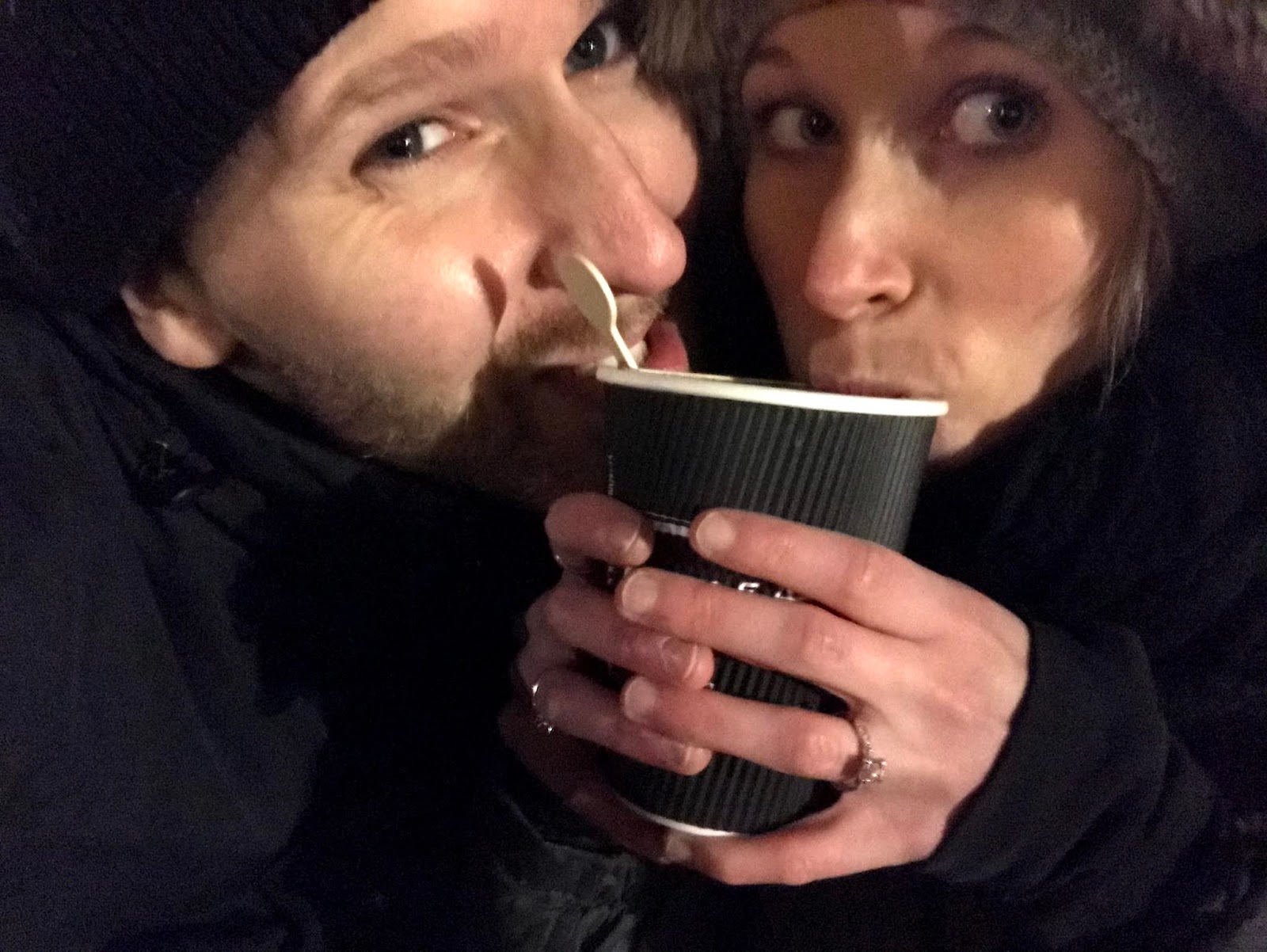
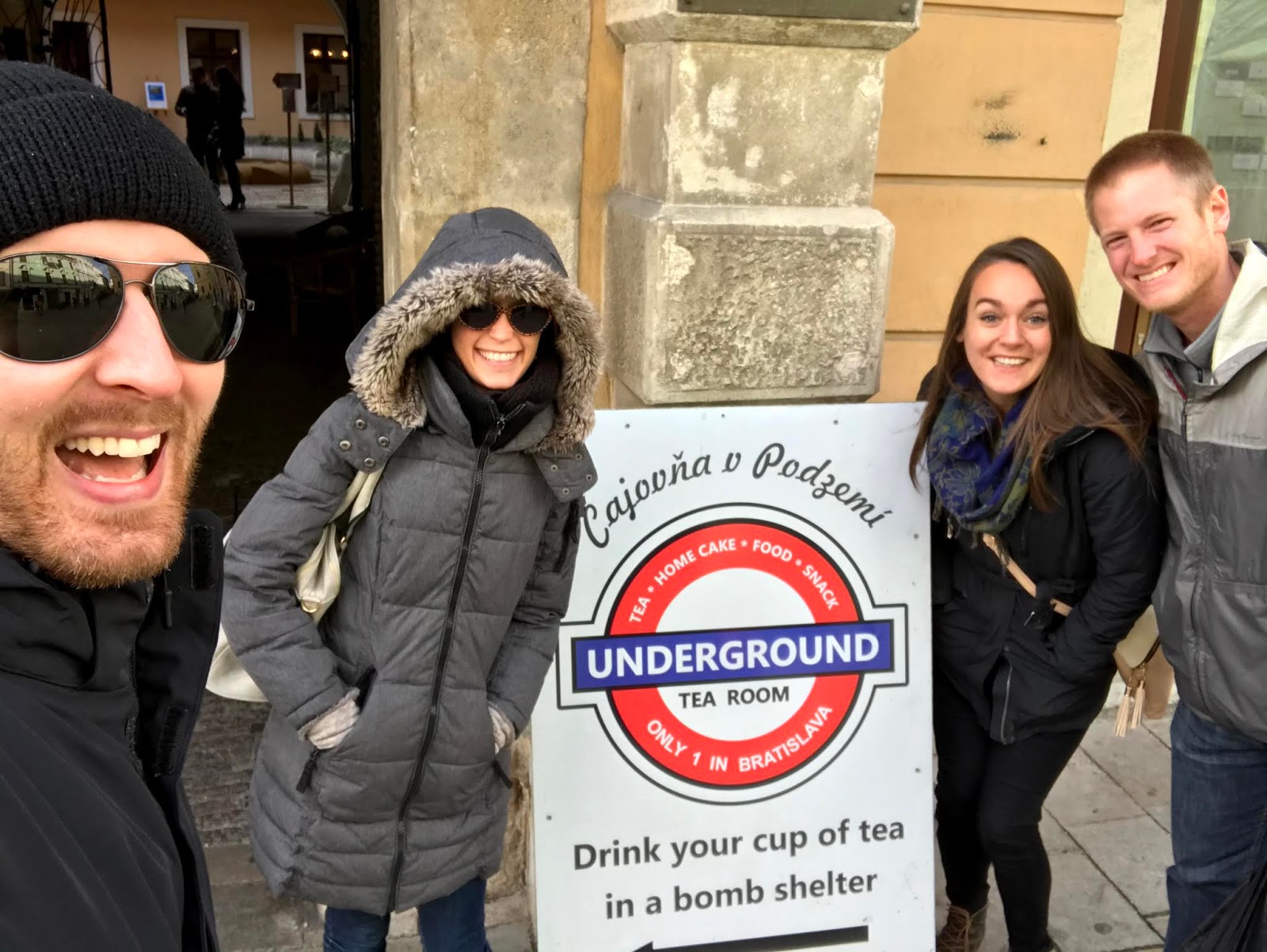
After eating our absolute fill (and enjoying a popsicle stick hot chocolate) Mark and I went to the underground tea bunker to enjoy a warm pot of Chinese fruit tea and to thaw our fingers and toes.
We met back up with Callie and Andrew for the bus ride back to Vienna. I would highly, highly recommend Bratislava to anyone visiting Vienna or the surrounding region. But enough about Slovakia, because we needed to get back to Vienna. We were trying to make the line for standing room only Opera tickets, unfortunately, due to bus blips and map malfunctions we didn't quite make it in time. (Guess it's a good excuse to go back!) Instead, the four of us competed in a scavenger hunt at the Christmas Market in museum quarter. We had so much fun! Some of the highlights included: making my own hot chocolate (with the direction and supervision of a vendor--- my hot chocolate game is forever better now!), finding my own personal nut cracker-- oh to have a husband of many talents!) and making a snow angel minus the snow. We had so much fun but the cold was starting to take its toll, so we headed to an eclectic local spot for a beer and a bite before bed. Prost to a great last night with friends in Vienna 🍻
Monday, December 2, 2019
a beginner's guide to everything but shopping on black friday
Friday 29 Nov 2019
We started our day with a free walking tour of the city. The spot we met used to host a building with an underground bunker for 300, however, during WWII during the air raids the building collapsed and killed everyone inside. To honor he victims nothing has been built on the site since. 100 feet away or so is a memorial honoring and remembering all of those who were affected during the war, germans, jews and civilians alike. There is even a sculpture depicting a woman giving birth, signifying the children, born and unborn, who lost their innocence because of the war. Below the memorial is a Jewish man on hands and knees, scrubbing the streets with a toothbrush. Although this is a very visual depictuon of the discriminations Jews faced during the war, many protest the statue-- how can Austria honor the Germans and the Jews in the same sculpture?
After leaving that contentious spot, we learned about the Austrian mentality for architecture: build it one way and add to it again and again. Because of this, many buildings have sections of baroque, neogothic and classical styles. Speaking of architecture, there's quite a story behind the opera house. Kaiser von Josef commissioned architects to build it. He gave them an unlimited budget and didn't ask to approve any of the plans before building. This resulted in an opera house that the Kaiser thought looked like a train station. He said as much, not to the architect but to someone else, and it resulted in the architect's suicide. The kaiser never said an unkind word ever again in his life.
The palaces of Vienna were home to the ruling family, the Hapsburgs. Maria Teresa was one of their most powerful and influential rulers. Before her father's death, he commissioned a document stating that Maria Teresa was fit to rule the kingdom, even though she was a woman. She had to defend this title time and time again, but had a circle of close advisors and confidantes who helped her stay in power. She had 16 children, all of who lived in the castle with her.
Her first daughter was her favorite and therefore was allowed to marry for love. All of the other children had arranged strategic marriages to help keep power in the family. Maria Teresa's elder son was frivolous and with money, so when his brother came into power he tried to limit the extravagant spending by enacting laws that allowed only one candle per funeral, and instead of elaborate golden caskets built with elevators (like his mother's), he designed a reusable wooden casket. Once the body was held over the earth, a lever was pulled and the body was deposited into the ground, leaving the casket free for the next funeral. The Hapsburg family had odd funeral rituals as it was. Their hearts were carved out and taken to the cathedral inside the winter palace and the intestines were carved out and taken to the cathedral inside the summer palace, before they were buried in the elaborate family crypt. While living, the Hapsburgs enjoyed luxury. Each family member was given 50 servants, all of who lived inside the palace, so at one time the castle was home to 5,000 people. With this many people the castle had to be quite large, however the floor plan wasn't ideal. The kitchen was located on one block but the dining room was in another. Servants had to run the meals back and forth from the kitchen to the dining area which resulted in most of the food being cold. During a normal dinner, 7 courses would be served. But, during official royal dinners there were 14. The male emperor at the time was known for eating incredibly quickly (7 courses in 30 minutes) which was problematic for the guests because they were expected to let the emperor have the first and last bite. Guests were never able to finish their meals and therefore it became a running joke that dining with the emperor really meant enjoying dinner afterwards at Hotel Sacher, a hotel that still exists today and claims the creation of the sachetorte, a famous chocolate and apricot cake. Their rival, cafe Demel, claims that an apprentice from their kitchen stole the sachetorte recipe and brought it to Hotel Sacher. The rivalry still exists today. Speaking of famous sachetortes, Maria Teresa had a major sweet tooth. She had no time to wait for the servants to run food from the kitchen to her quarters, so she had a bakery built underneath her chambers. Initially there were stairs leading to the bakery, but in her old age Maria Teresa gained quite a bit of weight and was unable to walk, so the stairs were replaced by a ramp.
In addition to having their own kitchens and bakeries, the Hapsburgs had their own cathedral with their very own Viennese boys choir. The boys were only allowed to sing from the age of 6 until their voices changed and then were retired. While being part of the choir, the boys had to attend school and keep good grades. Girls were allowed to attend the school, but not to sing in he choir. To this day the boys still sing in the church, but, are hidden from view because their voices are what's importsnt, not their faces (and then the choir can charge big bucks for private performances).
The Hapsburgs fought a lot of battles during their time but rarely won. There are two statues erected to honor the battles the Hapsburgs did win. One was against Napoleon. This was an important battle because up until this point everyone felt that Napoleon the conqueror was undefeatable. This victory changed the mentality of ruling families throughout Europe.
The Hapsburgs wanted to give back to the people, so created a public garden for them. In the gardens were halls where the the young generations danced the waltz (but not the traditional English waltz, but rather a faster more ,"risque" version of the waltz that the emperor disproved of). This is now known as the Viennese waltz.
It is here in the gardens that there is also amonument built to Sisi, Franz Joseph's wife from Bavaria. She was incredibly vain, so much so that she only drank raw meat juice for sustenance, laid fresh veal cutlets on her cheeks to avoid wrinkles and bathed in milk to keep her skin soft. She wouldn't allow anyone to paint her after the age of 30, for fear that she would be seen as old. Although Sisi sounds extravagant, her life was far from easy. Her first daughter died when she was only two years old. Sisi withdrew from her son, Rudolf, who was constantly at odds with his father, and allowed her mother in law to raise him. When he reached adulthood he took a mistress but soon after committed suicide with her. Sisi was distraught and left Austria so she could travel the world. She traveled for many years but died alone when she was stabbed in Geneva. Her husband was devastated.
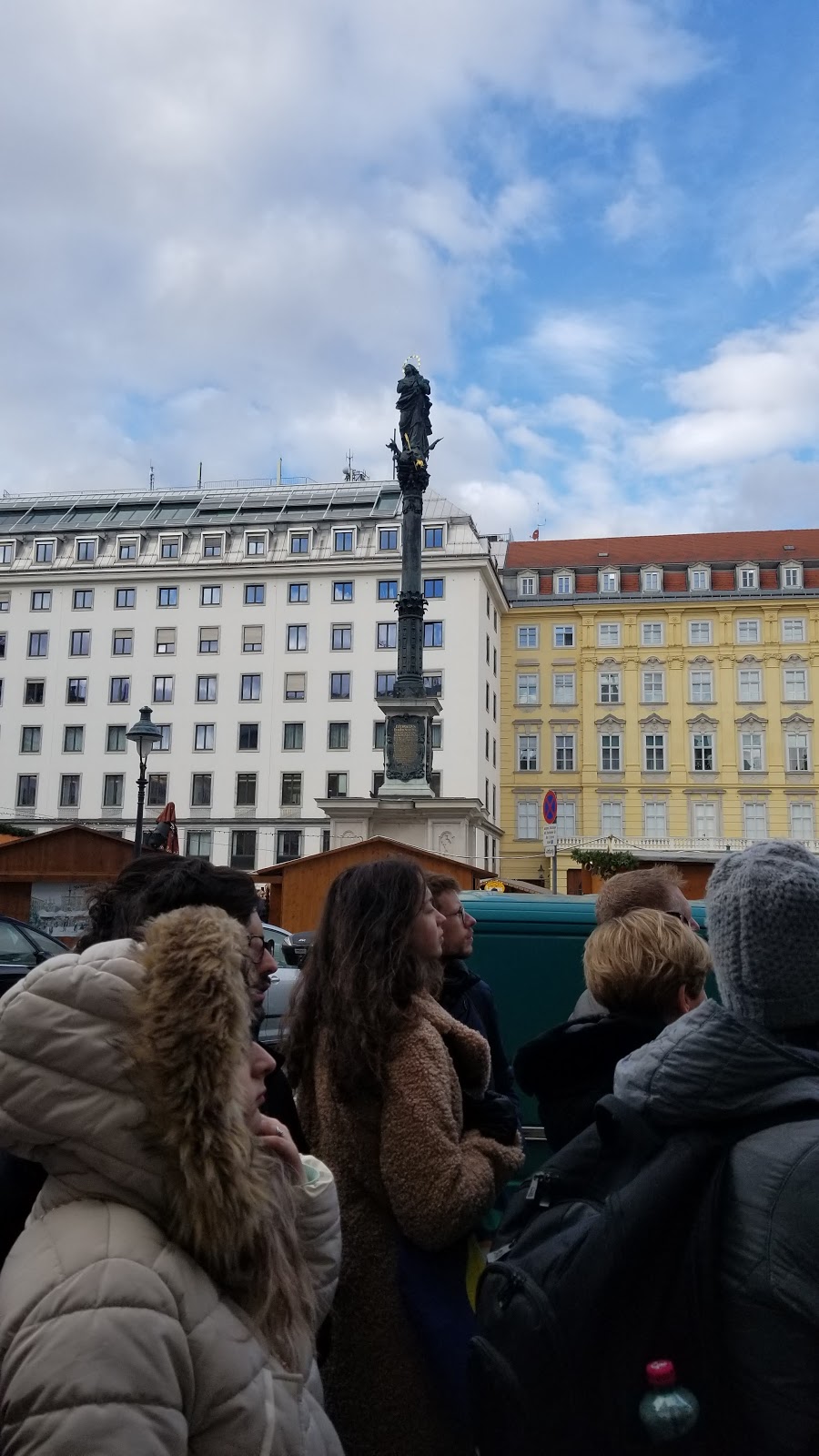
After visiting the gardens we walked to one of the main squares (during the time of the Hapsburgs it was used for public executions, but today there's a Christmas market there) This was also the first site for arms storage. Initially if Vienna was attacked, all of the common folk would run out with their guns and pitch forks to fight but that was clearly deemed ineffective, so a massive arms depository was created.
Close by is the Jewish quarter, which includes a memorial of thousands of books without names, representing the thousands of Jews who died during WWII. Advocates of the Jewish community appreciate that this memorial is for only Jews and does not include Germans like the one from earlier on in the tour.
Last but not least we visited St. Stephen's Cathedral. It has a famous, beautifully tiled roof with a double headed eagle. The roof and church interior were badly damaged from a fire during WWII, however all of the Austrian provinces gave money to restore the church to its original glory.
After the walking tour we grabbed a table at Demel to try the world famous sachetorte. I had franziskaner coffee with mine and it was oh so delicious!!
Coffee and cake were lovely, but the Christmas markets were calling our name. We went to our tour guide's fave spot first and enjoyed kasekrainer, aka grilled sausages with cheese in the middle, for lunch. Mmm fabuloso!
We topped it off with some gluwein and a walk around the market stalls.
We met ladies with tons of cheeses and spreads on offer, but the most interesting thing they sold were small wine beads. Imagine alcoholic gel coated capsules in poppable pill sized form. Just what the doctor ordered. We also enjoyed talking with an okarina maker. Okarinas are like small wooden flutes that are famous throughout Austria. Next door was a vendor selling homemade flavored moonshine. The samples were definitely delicious, but since he didn't have any travel size bottles it just wasn't something our carry on savvy selves could stomach purchasing.
After finishing our walk through the first market we decided we couldn't be one and done-ers, so we continued on to two more markets.
The second was HUGE and filled with so many lights, stalls and activities (there was even a ferris wheel and small nativity carvings here) while the third offered a respite from the crowds with plenty of tables to enjoy our gluwein in peace.
Dinner was definitely necessary, and after heading to a few different places we finally found a keeper. It was off the beaten path and offered really authentic, tasty food made to order. Callie, Andrew and I shared three different dishes that made the long trek in the rain oh so worth it.
To finish out the evening we played cards at an Irish pub and nommed on some Dondi's (you always want what you can't have!)
We started our day with a free walking tour of the city. The spot we met used to host a building with an underground bunker for 300, however, during WWII during the air raids the building collapsed and killed everyone inside. To honor he victims nothing has been built on the site since. 100 feet away or so is a memorial honoring and remembering all of those who were affected during the war, germans, jews and civilians alike. There is even a sculpture depicting a woman giving birth, signifying the children, born and unborn, who lost their innocence because of the war. Below the memorial is a Jewish man on hands and knees, scrubbing the streets with a toothbrush. Although this is a very visual depictuon of the discriminations Jews faced during the war, many protest the statue-- how can Austria honor the Germans and the Jews in the same sculpture?
After leaving that contentious spot, we learned about the Austrian mentality for architecture: build it one way and add to it again and again. Because of this, many buildings have sections of baroque, neogothic and classical styles. Speaking of architecture, there's quite a story behind the opera house. Kaiser von Josef commissioned architects to build it. He gave them an unlimited budget and didn't ask to approve any of the plans before building. This resulted in an opera house that the Kaiser thought looked like a train station. He said as much, not to the architect but to someone else, and it resulted in the architect's suicide. The kaiser never said an unkind word ever again in his life.
The palaces of Vienna were home to the ruling family, the Hapsburgs. Maria Teresa was one of their most powerful and influential rulers. Before her father's death, he commissioned a document stating that Maria Teresa was fit to rule the kingdom, even though she was a woman. She had to defend this title time and time again, but had a circle of close advisors and confidantes who helped her stay in power. She had 16 children, all of who lived in the castle with her.
Her first daughter was her favorite and therefore was allowed to marry for love. All of the other children had arranged strategic marriages to help keep power in the family. Maria Teresa's elder son was frivolous and with money, so when his brother came into power he tried to limit the extravagant spending by enacting laws that allowed only one candle per funeral, and instead of elaborate golden caskets built with elevators (like his mother's), he designed a reusable wooden casket. Once the body was held over the earth, a lever was pulled and the body was deposited into the ground, leaving the casket free for the next funeral. The Hapsburg family had odd funeral rituals as it was. Their hearts were carved out and taken to the cathedral inside the winter palace and the intestines were carved out and taken to the cathedral inside the summer palace, before they were buried in the elaborate family crypt. While living, the Hapsburgs enjoyed luxury. Each family member was given 50 servants, all of who lived inside the palace, so at one time the castle was home to 5,000 people. With this many people the castle had to be quite large, however the floor plan wasn't ideal. The kitchen was located on one block but the dining room was in another. Servants had to run the meals back and forth from the kitchen to the dining area which resulted in most of the food being cold. During a normal dinner, 7 courses would be served. But, during official royal dinners there were 14. The male emperor at the time was known for eating incredibly quickly (7 courses in 30 minutes) which was problematic for the guests because they were expected to let the emperor have the first and last bite. Guests were never able to finish their meals and therefore it became a running joke that dining with the emperor really meant enjoying dinner afterwards at Hotel Sacher, a hotel that still exists today and claims the creation of the sachetorte, a famous chocolate and apricot cake. Their rival, cafe Demel, claims that an apprentice from their kitchen stole the sachetorte recipe and brought it to Hotel Sacher. The rivalry still exists today. Speaking of famous sachetortes, Maria Teresa had a major sweet tooth. She had no time to wait for the servants to run food from the kitchen to her quarters, so she had a bakery built underneath her chambers. Initially there were stairs leading to the bakery, but in her old age Maria Teresa gained quite a bit of weight and was unable to walk, so the stairs were replaced by a ramp.
In addition to having their own kitchens and bakeries, the Hapsburgs had their own cathedral with their very own Viennese boys choir. The boys were only allowed to sing from the age of 6 until their voices changed and then were retired. While being part of the choir, the boys had to attend school and keep good grades. Girls were allowed to attend the school, but not to sing in he choir. To this day the boys still sing in the church, but, are hidden from view because their voices are what's importsnt, not their faces (and then the choir can charge big bucks for private performances).
The Hapsburgs fought a lot of battles during their time but rarely won. There are two statues erected to honor the battles the Hapsburgs did win. One was against Napoleon. This was an important battle because up until this point everyone felt that Napoleon the conqueror was undefeatable. This victory changed the mentality of ruling families throughout Europe.
The Hapsburgs wanted to give back to the people, so created a public garden for them. In the gardens were halls where the the young generations danced the waltz (but not the traditional English waltz, but rather a faster more ,"risque" version of the waltz that the emperor disproved of). This is now known as the Viennese waltz.
It is here in the gardens that there is also amonument built to Sisi, Franz Joseph's wife from Bavaria. She was incredibly vain, so much so that she only drank raw meat juice for sustenance, laid fresh veal cutlets on her cheeks to avoid wrinkles and bathed in milk to keep her skin soft. She wouldn't allow anyone to paint her after the age of 30, for fear that she would be seen as old. Although Sisi sounds extravagant, her life was far from easy. Her first daughter died when she was only two years old. Sisi withdrew from her son, Rudolf, who was constantly at odds with his father, and allowed her mother in law to raise him. When he reached adulthood he took a mistress but soon after committed suicide with her. Sisi was distraught and left Austria so she could travel the world. She traveled for many years but died alone when she was stabbed in Geneva. Her husband was devastated.
After visiting the gardens we walked to one of the main squares (during the time of the Hapsburgs it was used for public executions, but today there's a Christmas market there) This was also the first site for arms storage. Initially if Vienna was attacked, all of the common folk would run out with their guns and pitch forks to fight but that was clearly deemed ineffective, so a massive arms depository was created.
Close by is the Jewish quarter, which includes a memorial of thousands of books without names, representing the thousands of Jews who died during WWII. Advocates of the Jewish community appreciate that this memorial is for only Jews and does not include Germans like the one from earlier on in the tour.
Last but not least we visited St. Stephen's Cathedral. It has a famous, beautifully tiled roof with a double headed eagle. The roof and church interior were badly damaged from a fire during WWII, however all of the Austrian provinces gave money to restore the church to its original glory.
After the walking tour we grabbed a table at Demel to try the world famous sachetorte. I had franziskaner coffee with mine and it was oh so delicious!!
Coffee and cake were lovely, but the Christmas markets were calling our name. We went to our tour guide's fave spot first and enjoyed kasekrainer, aka grilled sausages with cheese in the middle, for lunch. Mmm fabuloso!
We topped it off with some gluwein and a walk around the market stalls.
We met ladies with tons of cheeses and spreads on offer, but the most interesting thing they sold were small wine beads. Imagine alcoholic gel coated capsules in poppable pill sized form. Just what the doctor ordered. We also enjoyed talking with an okarina maker. Okarinas are like small wooden flutes that are famous throughout Austria. Next door was a vendor selling homemade flavored moonshine. The samples were definitely delicious, but since he didn't have any travel size bottles it just wasn't something our carry on savvy selves could stomach purchasing.
After finishing our walk through the first market we decided we couldn't be one and done-ers, so we continued on to two more markets.
The second was HUGE and filled with so many lights, stalls and activities (there was even a ferris wheel and small nativity carvings here) while the third offered a respite from the crowds with plenty of tables to enjoy our gluwein in peace.
Dinner was definitely necessary, and after heading to a few different places we finally found a keeper. It was off the beaten path and offered really authentic, tasty food made to order. Callie, Andrew and I shared three different dishes that made the long trek in the rain oh so worth it.
To finish out the evening we played cards at an Irish pub and nommed on some Dondi's (you always want what you can't have!)
food, friends and football are what thanksgivings are made of
Thursday 28 Nov 2019
We started a four hour food tour at 9 this morning. There were three groups of Americans on our tour, all celebrating Thanksgiving abroad. We started at one of the few family run coffee shops with coffee, chocolate cake and apple strudel. What a fabulous breakfast.
We then walked to Naschmarkt, which is a bridge that's built with a market on top to link streets together. It's incredibly touristy, and our guide, Lukas, said that we should avoid all stalls but one, because the vendors charge high prices and don't source locally. We had a cheese board with goat, sheep and cow cheese. One of the cheeses is coated in burnt herb ash, which keeps it fresh, however, to distinguish it from the French style, the cheese has red chilis in it that merely add color, not flavor.
After Naschmarkt we walked to leiberkas-pepi, which is a famous homemade leiberkas shop that boasts 12 flavors, including lieberkas made from horse. We sampled 5. My favorite was the one that included pickles 😍 All 5 were supposed to be eaten with spicy mustard and horseradish, however, after one tasting of the horseradish I opted for just the mustard. Lukas explained that this shop is cheap and near the Opera because after locals and tourists spend all of their money on Opera tickets, they come here for a cheap and filling sandwich. (Sidenote: we also found out that you can get standing room only Opera tickets for 4 euro a piece as opposed to the seats that run from 20 euro to 200 euro and have an enforced dress code #foodtourforthewin).
After having our fill of lieberkas Pepi we went to a candy shop, one of the last that follows the traditional style of candy making. We watched a video showing the process, and saw that for the specialized candies it can take three workers up to 6 hours to produce one batch. We sampled coffee, hazelnut and glacier flavors.
After, we went somewhere truly special. Lukas took us into an underground cellar that used to function as a storage facility for an abbey, but was also used as a shelter during WWII bombings. It's from the 14th century. Now it's a winery/restaurant/music hall. It's rustic, charming and completely empty during the day as it's only open to the public in the evenings. Here we tasted three wines, all of which were mixes or blends. A mix changes from year to year depending on the harvest, whereas a blend is created one year and then the winery attempts to replicate it every year thereafter to preserve the integrity of it for the buyer.
After the winery we went to a chocolate shop, where we sampled two chocolates, one apricot and one chocolate with poppyseeds. I liked the apricot best. The chocolate shop had chocolates that were made from 100% dark, however they were all imported from other places, like Peru. I just didn't feel right buying Peruvian chocolate in a Viennese chocolate shop, so we'll have to wait and taste 100% chocolate elsewhere.
After we went to a bakery and sampled four different breads. The underground oven that the bakery uses runs 24/7 because it's more efficient than a traditional turn on/turn off oven.
We ended with a meat board from a butcher shop that included Vienna's version of beef jerky, thick straight from the bone ham leg and thin deli sliced ham. All were delectable. As always, the food tour was a great introduction to the city of Vienna and it's food culture. It was a great way to connect with locals and tourists and to get our bearings in a new city. We'll definitely be sampling more breakfast cakes (what a great way to start the day!), in addition to more Viennese meats and wines.
After heading back to our hostel to check in, Mark did some work and I showered while we waited for Callie and Andrew to arrive. Once everyone was settled, the four of us went for dinner at an eclectic burger joint. My club chicken sandwich (it was the closest thing to turkey!) was oh so delicious and had lots of pickles on it 😁
We were incredibly satisfied and stuffed by our Thanksgiving meal choice, so on to the next Thanksgiving tradition, beer and football. We went to four bars looking for TVs, but kept coming up empty handed. We finally found a festive Irish pub, the golden harp, that was not only playing football games, but also handball games. We enjoyed a few pints and then walked to a craft beer bar with over 75 beer choices- yum! The atmosphere here was lively, so the four of us settled in for a few rounds of Thanksgiving "what if" questions to finish out our evening. Of course we missed our loved ones from back home, but are so thankful we have friends abroad to spend the holiday with.
We started a four hour food tour at 9 this morning. There were three groups of Americans on our tour, all celebrating Thanksgiving abroad. We started at one of the few family run coffee shops with coffee, chocolate cake and apple strudel. What a fabulous breakfast.
We then walked to Naschmarkt, which is a bridge that's built with a market on top to link streets together. It's incredibly touristy, and our guide, Lukas, said that we should avoid all stalls but one, because the vendors charge high prices and don't source locally. We had a cheese board with goat, sheep and cow cheese. One of the cheeses is coated in burnt herb ash, which keeps it fresh, however, to distinguish it from the French style, the cheese has red chilis in it that merely add color, not flavor.
After Naschmarkt we walked to leiberkas-pepi, which is a famous homemade leiberkas shop that boasts 12 flavors, including lieberkas made from horse. We sampled 5. My favorite was the one that included pickles 😍 All 5 were supposed to be eaten with spicy mustard and horseradish, however, after one tasting of the horseradish I opted for just the mustard. Lukas explained that this shop is cheap and near the Opera because after locals and tourists spend all of their money on Opera tickets, they come here for a cheap and filling sandwich. (Sidenote: we also found out that you can get standing room only Opera tickets for 4 euro a piece as opposed to the seats that run from 20 euro to 200 euro and have an enforced dress code #foodtourforthewin).
After having our fill of lieberkas Pepi we went to a candy shop, one of the last that follows the traditional style of candy making. We watched a video showing the process, and saw that for the specialized candies it can take three workers up to 6 hours to produce one batch. We sampled coffee, hazelnut and glacier flavors.
After, we went somewhere truly special. Lukas took us into an underground cellar that used to function as a storage facility for an abbey, but was also used as a shelter during WWII bombings. It's from the 14th century. Now it's a winery/restaurant/music hall. It's rustic, charming and completely empty during the day as it's only open to the public in the evenings. Here we tasted three wines, all of which were mixes or blends. A mix changes from year to year depending on the harvest, whereas a blend is created one year and then the winery attempts to replicate it every year thereafter to preserve the integrity of it for the buyer.
After the winery we went to a chocolate shop, where we sampled two chocolates, one apricot and one chocolate with poppyseeds. I liked the apricot best. The chocolate shop had chocolates that were made from 100% dark, however they were all imported from other places, like Peru. I just didn't feel right buying Peruvian chocolate in a Viennese chocolate shop, so we'll have to wait and taste 100% chocolate elsewhere.
After we went to a bakery and sampled four different breads. The underground oven that the bakery uses runs 24/7 because it's more efficient than a traditional turn on/turn off oven.
We ended with a meat board from a butcher shop that included Vienna's version of beef jerky, thick straight from the bone ham leg and thin deli sliced ham. All were delectable. As always, the food tour was a great introduction to the city of Vienna and it's food culture. It was a great way to connect with locals and tourists and to get our bearings in a new city. We'll definitely be sampling more breakfast cakes (what a great way to start the day!), in addition to more Viennese meats and wines.
After heading back to our hostel to check in, Mark did some work and I showered while we waited for Callie and Andrew to arrive. Once everyone was settled, the four of us went for dinner at an eclectic burger joint. My club chicken sandwich (it was the closest thing to turkey!) was oh so delicious and had lots of pickles on it 😁
Earthquake Double Take
26 Nov 2019
I woke up a bit before 4am to go to the bathroom. After returning from the toilet I was lying in bed awake and the room started to shake. I immediately panicked-- another earthquake. I started shaking Mark (I'm aware of the irony here) and started saying his name loudly. He finally woke up and scrambled out of bed so fast he nearly fell over. We threw on shoes and raced out the door (all I could grab were my keys!) I looked and saw that Mark didn't have pants on, and while I'm used to this sight, I know the rest of Albania is not. I yelled for him to get his pants. He was so disoriented from being abruptly woken up coupled with the shaking that he was not at his best and brightest. The shaking was still happening as we took the stairs two at a time, Mark with his pants dangling over his shoulder. We made it outside into the cold night air and there were dozens of people, all in different types of pajamas, anxiously milling about. I made sure the first thing Mark did was put his pants on (call me crazy but I wouldn't run outside without pants, even during an earthquake) We sat on the stoop as cars started racing up our hill. Everyone was evacuating, but where to? This same thing happened the last time there was a quake. Mark and I made a plan to grab the things we needed as quickly as we could and then head to the park. We ran back in, quickly scoured the apartment for coats, water bottles and phones, and then left for the park. The night air was cold but the streets were buzzing with activity. So many people were wandering around, trying to figure out what to do outside of their apartments. Mark and I sat in the park for close to 45 minutes before we went back to the apartment.
We both laid in bed (socks, pants and sweatshirts were a required sleeping item this time around) but didn't sleep. It was near 5am. I got up around 630 to get ready for school and was bombarded with messages from colleagues. "Are you safe? Will there be school today? What if there's another quake?" I finally got the news that school had been cancelled at 710, and rushed to inform all of my coworkers. Unfortunately another quake took place soon after, this one more rolly than shaky. Mark and I left the apartment and headed to Tony's, one of our favorite American spots for breakfast. Here we both enjoyed hearty breakfasts while we watched the news of the devastation that took place in Durres and Thumane. We learned that the magnitude of the quake was 6.4, the strongest and deadliest to hit Albania in almost 40 years. Collapsed buildings killed more than 30 and left even more missing and unaccounted for. Rescue workers came from Serbia and Kosovo (which is in and of itself a potential natural disaster because these two countries hate one another), along with Italy and Turkey. However, rescue efforts were complicated because of continued after shocks that rolled through during the day on Tuesday and Wednesday. After breakfast I ran some errands. I then met Mark at his office to do some work on the computer (better to be in a building with multiple people than in my apartment building alone, right?) I met my coworker, Erin, for lunch and then we did some exploring of Tirana by foot. We found an amazing flower shop with all the feels and scents, a New York bagel shop that isn't amazing but will definitely curb the craving, and a vintage secondhand shop. The owner of the vintage shop told us about going to school for art. During her years of schooling the school chose the art domain for students, so she had been placed into sculpting. She hated it and quickly took up photography in her spare time. She visited one of the camps that was hosting kosovar refugees and came upon a little girl, not more than 3 or 4, who was getting her head shaved. She followed the little girl as she moved about the camp, capturing her innocence through photos. One of these photos is hanging in her shop today. On another wall is what looks to be a clothing magazine cover, however something is off. The owner explained to us that she flipped fashion on its head when she shot this cover using beggars from the street as models for the clothes. I walked away feeling better for having connected with this woman today. A group of us, still not wanting to face the reality of having to go home for the night, met for dinner to celebrate one of my coworkers birthdays.
I woke up a bit before 4am to go to the bathroom. After returning from the toilet I was lying in bed awake and the room started to shake. I immediately panicked-- another earthquake. I started shaking Mark (I'm aware of the irony here) and started saying his name loudly. He finally woke up and scrambled out of bed so fast he nearly fell over. We threw on shoes and raced out the door (all I could grab were my keys!) I looked and saw that Mark didn't have pants on, and while I'm used to this sight, I know the rest of Albania is not. I yelled for him to get his pants. He was so disoriented from being abruptly woken up coupled with the shaking that he was not at his best and brightest. The shaking was still happening as we took the stairs two at a time, Mark with his pants dangling over his shoulder. We made it outside into the cold night air and there were dozens of people, all in different types of pajamas, anxiously milling about. I made sure the first thing Mark did was put his pants on (call me crazy but I wouldn't run outside without pants, even during an earthquake) We sat on the stoop as cars started racing up our hill. Everyone was evacuating, but where to? This same thing happened the last time there was a quake. Mark and I made a plan to grab the things we needed as quickly as we could and then head to the park. We ran back in, quickly scoured the apartment for coats, water bottles and phones, and then left for the park. The night air was cold but the streets were buzzing with activity. So many people were wandering around, trying to figure out what to do outside of their apartments. Mark and I sat in the park for close to 45 minutes before we went back to the apartment.
We both laid in bed (socks, pants and sweatshirts were a required sleeping item this time around) but didn't sleep. It was near 5am. I got up around 630 to get ready for school and was bombarded with messages from colleagues. "Are you safe? Will there be school today? What if there's another quake?" I finally got the news that school had been cancelled at 710, and rushed to inform all of my coworkers. Unfortunately another quake took place soon after, this one more rolly than shaky. Mark and I left the apartment and headed to Tony's, one of our favorite American spots for breakfast. Here we both enjoyed hearty breakfasts while we watched the news of the devastation that took place in Durres and Thumane. We learned that the magnitude of the quake was 6.4, the strongest and deadliest to hit Albania in almost 40 years. Collapsed buildings killed more than 30 and left even more missing and unaccounted for. Rescue workers came from Serbia and Kosovo (which is in and of itself a potential natural disaster because these two countries hate one another), along with Italy and Turkey. However, rescue efforts were complicated because of continued after shocks that rolled through during the day on Tuesday and Wednesday. After breakfast I ran some errands. I then met Mark at his office to do some work on the computer (better to be in a building with multiple people than in my apartment building alone, right?) I met my coworker, Erin, for lunch and then we did some exploring of Tirana by foot. We found an amazing flower shop with all the feels and scents, a New York bagel shop that isn't amazing but will definitely curb the craving, and a vintage secondhand shop. The owner of the vintage shop told us about going to school for art. During her years of schooling the school chose the art domain for students, so she had been placed into sculpting. She hated it and quickly took up photography in her spare time. She visited one of the camps that was hosting kosovar refugees and came upon a little girl, not more than 3 or 4, who was getting her head shaved. She followed the little girl as she moved about the camp, capturing her innocence through photos. One of these photos is hanging in her shop today. On another wall is what looks to be a clothing magazine cover, however something is off. The owner explained to us that she flipped fashion on its head when she shot this cover using beggars from the street as models for the clothes. I walked away feeling better for having connected with this woman today. A group of us, still not wanting to face the reality of having to go home for the night, met for dinner to celebrate one of my coworkers birthdays.
Sunday, December 1, 2019
Our First Night in Austria
Wednesday 27 Nov 2019
After multiple earthquakes in Albania Mark and I were really looking forward to getting away for a long weekend. Luckily for us we made it out about an hour before a 5.3 quake which most certainly grounded some planes. We layed over in Serbia in one of the strangest airports I've ever been to. Security didn't occur until the gate itself. This wasn't odd except for we weren't allowed to enter the security line until the time our flight was supposed to board. In addition to this, the metal detectors and security belts immediately followed the line so a bottleneck effect occurred very early on. Overall it was inefficient and caused our flight to be delayed. No matter however, because we still reached Vienna by 815, had a smooth trip through customs and were into the city center by 9 via the CAT. We then took the underground to our hostel where we were able to check in right away. We dropped our bags and headed to a very traditional Viennese bar/restaurant, called Gastwirtshaft Schilling. I ordered hearty, hot, traditional soup with noodles, vermicelli and veggies, while Mark ordered blood sausage, sauerkraut and potatoes. The waitress recommended a local Austrian beer that was light and delicious. What a great first night in shakeless Austria.
Subscribe to:
Posts (Atom)